13 October, 2017

Is Driving (to and from work) a Right or a Privilege?

Courts are increasingly indicating their agreement with the view that suspending driver's licenses for certain offenders is unconstitutional and a violation of individual civil rights. This is especially so when it is held that licenses of indigent traffic offenders are lifted for failure to pay cascading fines and fees without benefit of some sort of means testing or harm reduction being considered.

http://reason.com/blog/2017/10/10/federal-judge-reinstates-suspended

I propose (modestly) a solution:

While I maintain that automobile ownership and use is actually a privilege as opposed to a God-given (or state-given) immutable right, it is clear that in many parts of the U.S., the ability to drive, or more to the point, access to private point-to-point personal transportation is essentially a necessity. Removing that access is a draconian measure and may perpetuate a cycle of poverty and law-breaking.

So how about this very simple solution? Local governments/municipalities establish and subsidize ride-share programs that get those that have lost their licenses to and from work, grocery stores, churches, the doctors, the library, etc. If you drive your own car for these purposes, it costs you something in terms of gas, insurance, maintenance, etc., so it would be only fair and reasonable for program participants to contribute those amounts towards their share of the project. The subsidies I mentioned would cover the shortfalls.

Participants might rely on Uber (a boost to Uber drivers), or ride-share in personal cars driven by others. It might be possible and even desirable if some program participants act as drivers, their license suspensions lifted in exchange for performing this task.

As a condition of program participation, a payment plan would be set for the fines and other fees that are currently blocking individuals from reinstating their licenses.

So how does that sound?

03 August, 2017

Is Corporate Diversity Real or is it a Game?

Yet again, "diversity" is being viewed as some extrinsic quality that by simple inspection can be identified, categorized, quantized, and classified. "Let's see, we need so many blacks, a few white males, some gays, as many increasingly au courant transgenders (male and female, pre- and post-transition) as we can find. Cross-dressers are always handy for immediate impact in the annual report... And then season with some women and those spicy Latinos. There, perfect." 

This form of diversity, if looked at objectively, might just as easily be deemed racism. True diversity is based on what the constituents of a company's workforce bring to the table based on: life experience, culture, education, ways of thinking, etc. It is definitely not, "Get me some Jewish guys because they'll be really good at contracts, and then some Asians because, you know, they're all great with numbers."

This goes back to the classic "nature versus nurture" debate: some of the dimensions of diversity may be "baked in" and carried by some ethnic or other affinity/identity group, but to totally rely on this to achieve an important goal is simplistic, overly reductive, and prone to failure. Perhaps worst of all there is a high likelihood of its either being perceived as or actually being a cynical ploy to keep government and activists off your back.

If diversity is important enough to do, it's important enough to do for real.

https://hbr.org/2017/08/deloittes-radical-attempt-to-reframe-diversity

01 August, 2017

Why is the "Developing World" Still in Very Dire Need of Development?


Executive Summary: If you give a bunch of poor people a bunch of money and do nothing else for them, in the short term you'll have a bunch of poor people with money. In the long term, you'll again have a bunch of poor people. This is the state of things in Latin America, pockets of the United States, the middle east, and much of the continent of Africa (I feel the need to stress that Africa is indeed a continent, as many people, especially in the U.S., seem to view it as a monolithic country).


An article appeared today on Quartz (https://qz.com/1024546/stop-blaming-poor-countries-poverty-on-corruption-sometimes-its-just-bad-luck/) titled, "Stop blaming poor countries’ poverty on corruption—sometimes it’s just bad luck."

If we accept the hard luck thesis, it doesn't leave us much in the way of constructive ideas as to how to be of assistance in improving the lives of people in these benighted precincts. After all, how does one change luck for the better? If life is nothing more than a succession of (fair) coin flips, is there anything within the laws of physics that can guarantee nothing but heads coming up?

Having the temerity to observe that because, largely due to human nature (which can be pretty darned inhuman), oligarchy, corruption, theft, graft, "kleptocracy," and "the resource curse,"a lot of people in the world are stuck in poverty is not the same as shaming the poor and oppressed as being morally flawed. But demographic, social, and societal problems have taken generations to take root and result in the status quo that we see. Fixing problems of economics, education, health & welfare, and lack of opportunity for upward movement are not reasonably going to be amenable to an overnight fix. Bill and Melinda Gates, as a case in point, have done admirable and compassionate work to improve availability of drinking water in parts of Africa. Despite the dollars invested in easing this problem, the efforts still appear to stall when they confront the issue of sustainability. So, for example, a village water pump stops working because no one in the village understands how to replace a fan belt and the village is back to women carrying jugs of water on their heads.

A lot of well-intentioned people in the west seem to view large swathes of the population of Africa the way marine biologists view dolphins: "They're super smart and industrious and the only reason they never invented the radio is because they live in water which would short everything out."

30 July, 2017


Why it's a bad idea to eat late in the evening. A prescient message for @ulalaunch @torybruno @SpaceX and @blueorigin ? A story of angst and foreign object damage? I had a vivid dream last night. A dream so strange it positively screams out to be documented. It has quite possibly changed my entire outlook on life and the nature of reality: 

My boss (whoever that was,
I never saw him – only heard his voice)) showed up at the house, urgently waking me to tell me I needed to get to a very important meeting. It was at the factory of a rocket engine manufacturer that had some sort of technical problem causing their engines to fail and blow up. I quickly threw on a blue seersucker suit (just like the one younger my brother wore to our nephew's wedding in Nashville last October). The boss approved of the choice and left to go on his own to the meeting.

I had a little lamp at bedside but was unable to turn it off. It had about six switches, but none of them seemed to do anything, individually or in combination, other than make it brighter. Finally, I just unplugged it. It was at this point that I noticed a small hole in the left leg of my suit pants
a few inches above the knee. It didn't seem to be a tear, but rather a circular hole due to wear, I’d guessed. I decided to keep the suit on since time was growing short and I needed to get going for the big meeting.

I walked into the bathroom to brush my teeth. Floating in the toilet was a capsule-shaped pill that was red and brightly striped
in a spiral. The colors were like a rainbow. It was gigantic for a pill one would be expected to swallow, at least 3 inches in length and maybe three-quarters of an inch in diameter. Next to it was a gray feather. Seeing that pill floating in the toilet invoked a feeling of deep existential dread in me for an unknown reason. I felt sick. I knew it was my wife's, but what was it for and why had she thrown it away? Did she leave it there intentionally for me to see? Just then, the wife (whom I had never seen before, though this didn't strike me as at all remarkable) entered the bathroom. She had what seemed to be reddish shoe polish on her face where a man might have a mustache and beard. It looked a bit like Kirk Douglas’s beard in ‘Lust For Life.’ "This marks the facial hair I'm going to remove; don't worry, this will all just come right off," she told me.

Next I know, I'm in a vehicle driven by
a good friend and former co-worker, Glenn. I say ‘vehicle’ because I'm not sure if it was a car, a van, or a truck. I'm not sitting but rather stretched out horizontally on my back with my feet at the back. We're on our way to the meeting at the rocket company. "Hey, I forgot my shoes," I tell Glenn. I'm hoping he'll turn back at the one opportunity to make a quick turn back. Instead, he passes it and presses on. We both know that there's no time to go back to get my shoes, especially now that we're on a road with no options for turning around. I'm thinking that my boss (and possibly my wife) are already en-route and maybe ten minutes ahead of us.

Glenn pulls into a MacDonald's drive-through and asks if there's a shoe store nearby. The kid in the window (who has the same croaky, breaking voice as the teenager in 'The Simpsons') tells us there is, just around the corner behind the MacDonald's, but
that he doesn't know how to get there. "You have to go through the junkyard," he says. Glenn and I both realize that neither the junkyard nor the shoe store will be open at this early hour. We also feel the pressure of time.

We pull out onto the street where we pass a couple of bums
(And I say ‘bums’ because they look like hobos from the 1930’s, carrying belongings in bindles on the end of sticks hoisted over their shoulders. They both wear fingerless gloves, the utility of which I’ve never quite figured out.). I ask if they have any shoes they'd sell me. On of them offers up several pairs, but they're all obviously too small. This prompts me to tell them that the size I need is ten and a half (which is untrue since I’m a size eleven and a half). The other bum removes his own beat up pair in that size, but I tell Glenn, "It's no good. They're brown. They won't go with this suit. So we drive on until we stop outside a Subway store. Glenn runs in and quickly returns with two foot-long sandwiches; tuna, I think. Clearly, his intent is for me to somehow clamp them to my feet. I try, but there's no way to make it work.

Now we're in the lobby of the rocket engine plant. I'm barefoot and stressing out over this. On the wall is a chart with the specifications of all their products
arranged from smallest to largest. The thrust of each is listed in Newtons, and I'm trying to convert them to pounds. I have no feel for what a Newton is. Our hosts arrive. Looking down at my bare feet, the chief engineer says, "I get it! I get what you're trying to tell us! The problem we're having is contamination and we can solve it by having all of our employees remove their shoes before entering the production floor. Thank you!" 

09 October, 2015

VW TDI EMISSIONS MESS: WHERE ARE WE WITH THIS?

Affected U.S. vehicles (~482,000 total)


VW Jetta TDI (Model Years 2009 – 2015)
VW Jetta SportWagen TDI (Model Years 2009-2014)
VW Golf TDI (Model Years 2010-2015)
VW Golf SportWagen TDI (Model Year 2015)
VW Beetle TDI and VW Beetle Convertible TDI (Model Years 2012-2015)
VW Passat TDI (Model Years 2012-2015)
Plus Audi A3

VW AT RISK


This scandal is an existential threat to VW. This based on the financial and legal risks they face along with the possibly fatal loss of confidence in the brand of what is now the world's largest automaker.

Driving through Houston, I've already seen billboards soliciting plaintiffs in anti-VW lawsuits. Television commercials normally targeting medical malpractice and "bad" medical devices and drugs, are now sharing the spotlight with ads against VW. Since emissions compliance is regulated at the federal, state, and in many cases county levels, VW faces lawsuits from potenitially hundreds of entities. Harris County Texas, where Houston is (mostly!) located, has already filed suit.

I imagine individual owners could easily find lawyers willing to prosecute suits based on fraudulent and deceptive trade practices. VW faces a "death of a thousand cuts" scenario.


AFFECTED CARS CERTAINLY WON'T BE IMMEDIATELY BANISHED FROM U.S. ROADS


The California Air Resources Board (CARB) that rules over emissions law in that state and indirectly in other states, has announced that it will not, for the moment, take action against owners or their cars when it comes time to register or sell their Volkswagen diesels. "There should be no impact at this point, because the investigation is ongoing," CARB spokesman David Clegern told Consumer Reports.


UNINTENDED CONSEQUENCES: OWNER REBELLION AND A NEW BLACK MARKET EMERGING?

It's been pointed out that there is no absolute leverage (under current law) by which municipalities and even the federal government might compel owners of affected cars to accept a software solution. And folks may resist such a solution if it is perceived as adversely impacting mileage, performance, or driveability. In jurisdictions where there is no standard for diesel emissions or a testing protocol as part of the registration and safety inspection process, a large number of car owners may choose to simply shun any fix. 

I have to speculate that enterprising individuals may create a market for "black market" engine control firmware "downgrades" that reverse the VW fix, whatever it turns out to be.


RESALE VALUES ARE TAKING A HIT

Wholesale auctioneer Manheim typically sells about 50 used TDIs per week, among those models involved in the emissions debacle, with about 70 such cars listed for 'upcoming auction.' However, Manheim’s most recent numbers are 15 cars sold and 11 cars listed.SIX POSSIBLE VW TDI DIESEL RESOLUTIONS

Resale values in the U.S. have taken a substantial hit in the weeks since the emissions scandal emerged, falling an average of 13%, or about $1,700 per vehicle since mid-September as car dealers stay away from the tainted vehicles, according to respected used-car pricing guide Kelley Blue Book.

“Early indications from auctions are that dealers are more hesitant to buy the VW diesel units,” KBB’s lead product analyst Tim Fleming said. “Used car values typically decline at this time of the year, but the large price drop on the VW diesels certainly stands out.”

The number of affected VW diesel cars being sold at auction has also tumbled 27% in the last two weeks, KBB says.

BUT DON'T PANIC - YET

Affected owners should “wait and see” if VW decides to issue compensation (direcSIX POSSIBLE VW TDI DIESEL RESOLUTIONSt cash, credit towards another VW), a buy-back, etc.) or issues a widespread recall. Owners are smartest to refrain from immediately selling their cars. Any sale in the short term will be for a low value, since dealers have yet to find out the necessary costs of repair for these vehicles. Additionally, Volkswagen has yet to announce its solution, deterring potential buyers who may have to deal with further action from the auto maker.

In the three states (California, Texas, and Florida) with the most VW diesel cars caught up in the emissions scandal, only California withholds registration renewals from cars that fail to comply with recalls. In Texas and Florida, which have the second- and third-highest number of VW diesels after California, there are no emission standards in place for diesel vehicles.

Nationally, only 17 states are required by the Clean Air Act to confirm that owners of cars subjected to a recall show proof they have complied with it betoughfore they are allowed to take an emissions test required to register their cars, the Environmental Protection Agency said.


SIX POSSIBLE VW TDI DIESEL RESOLUTIONS

The following fixes/resolutions are ranked from most likely to unlikely:

1) "RE-FLASH" THE ENGINE CONTROL UNIT FIRMWARE TO REMOVE THE "TEST CHEAT": VW hopes that a simple software fix will work, and this is the most likely fix according to VW. I doubt this for an inescapable reason: if such a simple solution to the emissions and performance issues existed, VW engineers would have done this to begin with. Obvious issue with this sort of easy modification is owners may object that performance and driveability are sufficiently changed (for the worse) as

2) USE MORE ADBLUE (DIESEL EXHAUST FLUID (DEF)/UREA): For the subset of vehicles already fitted for selective catalytic reduction (SCR) and accompanying urea tank, VW states that a combination of both a software fix and greater use of ADBLUE may allow TDI's to comply with U.S. emissions regulations. This approach might work for 2012-2015 Passats and 2015 Golfs. VW would probably be compelled to supply owners the additional ADBLUE at no charge, but again the specter of the car not being what they bought (requires more frequent refill of Adblue fluid).

3) CASH COMPENSATION FOR CURRENT OWNERS: VW will most likely be required to send each owner of an affected vehicle a payment of some sort to account for diminished resale value, reduced mileage and performance, and increased future service costs. How this value gets determined and owner's rights to reject it in pursuit of a larger settlement is a question.

4) RETROFIT AN SCR SYSTEM: Doing this would be complicated, time-consuming (for VW, dealers, and owners) and expensive. Adding SCR (avoidance of which probably got them into this mess in the first place); the urea tank, filler location, associated pumps, sensors, plumbing, and wiring to vehicles in the field would be a 6) SWAP OUT NON-COMPLIANT TDI's FOR NEW MODELS: major undertaking. Owners would not be thrilled with losing trunk space, fuel tank capacity, or possibly the spare tire to the urea tank, along with the cost and inconvenience of having to periodically refill the fluid. This fix could cost VW $5K - 8K per vehicle.

5) JUST BUY BACK THE CARS OUTRIGHT: Any TDI that could not be brought into compliance with software tweaks owners would accept would be bought back and destroyed. VW stated that average buy back price would be $15,000.00 for a total cost of $4.5 Billion.

6) SWAP OUT NON-COMPLIANT TDI's FOR NEW MODELS: VW stated this would be the most costly solution.

07 January, 2014

Elastic Collisions: The Limits of Dynamic Pricing

Early New Year's morning an Uber user paid $82 for a one mile ride. My first reaction to this news is that the rider appears doubly stupid: first for paying $82 for a one mile ride; and second for admitting to having paid $82 for a one mile ride. But the experience has kicked off a debate or at least a renewed awareness of dynamic pricing for goods and services.

Obviously the theory of dynamic pricing is to efficiently, some would say ruthlessly, match supply and demand for a given product or service at a specific time and location. In this regard, it's exactly analogous to how a *skilled* bookie uses the odds he sets to ensure he has as many bets for team A as for team B. So catching a cab at 1:47 AM on New Year's Day might be a high demand proposition. On the supply side of that transaction, I guess it's possible that some drivers might decide to be off duty at this time, thus lowering the supply, but I suspect the imbalance is mostly on the demand side of this particular transaction.

Balancing supply and demand assumes a certain amount of elasticity in both supply and demand. If the asking price of a service rises beyond a "threshold of pain" for a specific consumer, it is reasonable to assume that they will not engage in the transaction at that price. Personally, I'd have to be in an amazingly compelling scenario in order to knowingly and willingly pay $82 for a ride of one mile.

On the supply side, the elasticity is manifest in drivers' decisions to be out on the road offering rides. If a driver knows he or she can charge let's say 10% more than normal for a ride, some of them will find this premium attractive; others may decide that 10% is not enough to incentive roaming the streets at two AM on January 1st. Obviously, as the premium rises, so too does the number of drivers that will decide to enter the market.

The dynamic pricing model faces a limit to elasticity on both supply and demand sides. Above some price, the overwhelming majority of consumers will not buy. Below some price, suppliers will not find it worth their time to compete for customers. Obviously, this elasticity is in constant flux, is situation, and is temporal. When the IRIDIUM satellite phone system made its debut, I was asked who would be willing to pay more than $7 per minute to place a phone call. I assumed that two plausible answers were: a CEO who wasn't particularly sensitive to spending $7 per minute at any time and an arctic explorer who wished to call for help after a polar bear had bitten his leg off to whom money was no object at that specific time. My family goes through maybe two gallons of milk per week. Like George H. Bush, I will confess to being a bit hazy on the price I pay per gallon, but let's assume it's around three dollars. If it goes a bit higher, say to four dollars, our buying habits likely will go unchanged. But if the price suddenly went to eight dollars, I'd examine alternatives, including just shunning milk.

Efficiency in a market and how it sets prices (i.e., values things) is also limited by how promptly the links between supply and demand (and their respective elasticities) are mediated. The energy industry is an example of delayed market signals (or their realization) leading to unfortunate investment decisions. This is because while a cadre of Uber drivers can decide almost instantly to take to the streets, it can take a decade to carry out a plan to find and exploit energy resources.

The other limit to elasticity is information. Do prospective buyers know what the current going rated is and what the cost drivers are? Do suppliers know how many buyers are out there, how many competitors are in the game, and what strategies both buyers and sellers are using? An efficient and fair dynamically priced market also assumes a high level of information symmetry: buyers and sellers all have the same information upon which to base decisions. Automated systems like Uber ought to easily meet these criteria.

So why someone chose to spend $82 to be carried a mile escapes me, but I assume some other factor was at play. Maybe intoxication, seriously inclement weather, the desire to impress a date (or having done so, the urgency to whisk that date to one's apartment before the bloom falls off the rose)? All I can say is that if I willing paid $82 for a one mile trip, the destination would be a hospital and I'd be apologizing to the driver for all the blood emanating from my polar bear severed leg.

06 January, 2014

*Asterisk*: Government Subsidies and inducements and alternative energy winners and losers

You can look at subsidies in two ways: as a consumer; and as an investor. We could also have a third prospective, that of a taxpayer, but that will probably just make you angry.

Let's say that aided by state and federal tax credits you can purchase a very desirable Tesla for the price of a 3-series BMW. As a consumer, that can be a great deal assuming the Tesla is the car for you. Once you make the purchase, your savings on "the real cost" of the car are locked in and you should be quite pleased.

As in investor, you might decide that Tesla has a tiger by the tail and that you'd like to get in on that by buying a small slice of the company. You can study projections for sales and expected profit margins, the typical financial underpinnings of any investment target. But you would be unwise to neglect investigating the role that subsidies play in the business. To what extent are they driving sales and how long are they likely to remain in place? Who are the competition and what might they do to reduce Tesla's subsidies or get some of their own? What is the future of carbon credits that prop up Tesla's margins right now? What are the economics and sustainability of Tesla's free SuperCharger stations? Who pays to maintain the integrity and capacity of local power grids when 100,000+ EVs are charging in the evening?

Similar questions exist for solar, wind, and geothermal energy. Subsidies will certainly reduce your installed price per kilowatt-hour. But how long of a "free ride" can you count on in the form of laws requiring your local utility to purchase from you your excess power while relying on their base-load safety net? Who pays to maintain and synchronize the 60 cycle AC we all assume is present at every wall outlet? These issues affect both consumers and investors and are significant drivers to the long-term viability of these energy sources.

Another, less obvious, variety of subsidy is where the government enters into a lucrative and possibly very large contract for services with a relative newcomer to the field. This is the case in commercial space launch services.

When Roger Maris had his 61 home-run season, breaking Babe Ruth's record, many baseball purists insist the record have an asterisk attached to it. The asterisk would denote that Maris accomplished his feat in the span of a 162 game season, while Ruth did his in the days of the 154 game season. If folks can get worked up about that distinction, a giant asterisk is certainly merited for the artificial subsidies, credits, legislation, and other inducements that tilt the cost:benefit equations for alternative energy products and sources.

Consumers can ignore (or just be pleased by) what's behind the asterisk as it lowers their purchase price below the true cost. But they must still remain wary of how their ongoing future operations and other cost of ownership items are affected.

Investors are foolish to ignore the asterisk as what's behind it can make or break the viability of their long-term bet.

10 December, 2013

What we've been working on at CAU: an automated pilot's advisor based on cockpit data fusion


As always, two truths remain immutable: there is nothing new under the sun, and great minds think alike. And to these, perhaps we can add a third: better late than never.

A client tasked us with defining detailed functional requirements for an "add-on" pilot's aircraft performance monitoring and advisory system for application in transport category airplanes (i.e., "big iron"airliner types). We named the system PASS -- Performance Advisory Safety System.

The initial instance of PASS is laptop-based with access to aircraft system parameters via a standard data bus interface. The first requirement for PASS is to pose no risk to aircraft systems, so its interaction on the bus is entirely passive monitoring and data collection. All transactions are one-way. A subsequent iteration of PASS functionality can be integration into an existing flight management system (FMS). 

What PASS does is automate performance monitoring tasks such as:
  • Calculate V1 speed
  • Determine CG location and verify within limits
  • Monitor expected/acceptable acceleration during takeoff
  • Verify airspeed indicator "aliveness" and consistency during takeoff roll
  • Perform in-flight "reasonableness and consistency checks" across data such as throttle settings, fuel flow, EGT, airspeed, and attitude
  • Verify aircraft configuration is appropriate for flight phase.
An important PASS function is to assist flight crews in resolving dilemmas posed by failed instruments, displays, or the data sources driving them. For example, PASS can diagnose and warn of a failed pitot-static system by comparing all airspeed and static sources with aircraft configuration, flight path angle, and engine outputs, 

In response to system faults and failures that it detects, PASS integrates the appropriate checklist, POH information, and system malfunction procedures, thereby optimizing cockpit resource management and reducing crew workload.

We've completed the initial set of requirements and are ready to move into the next phase -- a working prototype to allow demonstration of the concept as well as collection of flight crew comments and other inputs. 

We are encouraged that others are thinking along similar lines:


15 August, 2013

3 Basic Flying Rules to Live (and Keep Alive) by


Flying in all its forms is remarkably safe considering the unforgiving nature of the environment pilots operate in. A fundamental way to keep operations as safe as possible is to be mindful of and adhere to three basic rules. These apply to normal as well as unusual and emergency situations. Following them will go a long way to keeping normal flying from becoming emergency flying.

The rules are:

1). AVIATE
2). COMMUNICATE - and-
3). NAVIGATE

I've presented them in descending order of priority, but a pilot or crew absolutely has to do all of them. Here's how it works:

Aviate. Simply put, someone must always be flying the airplane. This means tending to the basic stick and rudder functions and the care and feeding of the systems that keep you aloft and in controlled flight. With more than one pilot, it is crucial (but unfortunately not sufficiently obvious) that someone has to be unambiguously responsible for flying the airplane. You can rely on automation to relieve some of the second by second workload, but can never abdicate control of your fate to an autopilot. The monitoring and assessment tasks you perform as a pilot are identical irrespective of whether you are hand flying, using a wing leveler, or a full-blown multi-axis autopilot. The rule applies to your Cessna-150 or a Boeing 747. One area of special emphasis is your response to abnormal flight situations. The temptation is powerful to devoting all the brainpower in the cockpit to solving a systems problem. This temptation has to be avoided by a one person crew as well as a multi-member crew. And one person has to be clearly in charge.

This brings us logically to our next rule;

Communicate: This is how everyone knows who is in charge, who is doing the flying ("I have the airplane", is a good declarative statement to make. All the better when it is clearly and promptly responded to: "Roger, the airplane is yours."), and what the gameplan is. Communication is a fundamental and essential element of effective resource management for a multi-person crew. Another dimension of communication is external to the cockpit. You have to ensure that ATC personnel and, as appropriate, other users of the airspace, know where your are, where you're going, what your situation is, and any other factor that forms what we will refer to as "your intentions." If you have passengers, it is certainly helpful to apprise them of the situation and your intentions.

And this leaves the final rule;

Navigate: By this I mean more than X marks the spot on a sectional chart. You must navigate successfully through the landscape that is your total situational awareness. Knowing about the terrain below you; relative range and headings to airports, fields, and other landing opportunities, and their conditions; and the location of nearby traffic is critically necessary but not sufficient. You must also address things like your fuel situation, weather, and aircraft system status. When you're successful navigating, the intentions you formulate will always be within the capabilities of your crew as pilots, and of your aircraft.

12 August, 2013

A STRANGE CONFLUENCE OF EVENTS

Whitey Bulger, notorious Boston organized crime figure, informant, and long-time fugitive, was found guilty of racketeering, conspiracy, and murder today. He was acquitted of a lesser federal offense of dancing with a mailman. Auspiciously, his guilty verdict comes on the same day as Elon Musk's disclosure of the plans for his Hyper Loop transportation system (some assembly required).

This got me to thinking about all the technological wonders and societal developments we are on the very verge of...

When Whitey is sentenced, his story might very well go *something* like this:

1). Federal Marshals on Segway scooters will escort him to a central transportation mode where;

2). He will board a hyperloop "train" to the node nearest the federal prison where he is to serve out his sentence. He will arrive at his destination 16 minutes before he left.

3). Transport from the node to prison will be via a Tesla Model W sedan that will make use as required of supercharger stations along the route. For security reasons, robotic battery swaps will not be used. Marshals have been instructed to make judicious use of air conditioning and headlights and to ensure that New York Times (paradoxically enough now owned by Elon) reporters and the gang from Top Gear are kept at least 300 miles from the planned route which will be cleared of the typical hordes of Google self-driving cars that have not yet collided with each other due to subtle bugs in their Ubuntu 17.04 operating systems.

4). Electricity to power the chargers will have been derived from room temperature fusion contained within a 1000mL laboratory beaker augmented by a Kenner Easy Bake Oven purchased off of Ebay and slightly modified in Italy. If accomplished entirely during the daytime on a sunny day, or if conditions in the region are suitably blustery, the option exists to power the journey entirely with renewable energy. In this event, Bulger will be credited with a $2500.00 green energy rebate.

5). Federal agents will keep to their tight delivery schedule by frequently consulting Apple Newton devices.

6). If Bulger misbehaves while in the custody of his terrestrial prison, he will be transferred to the Bigelow Inflatable Incarceration Facility (BIIF) in geostationary orbit over Devil's Island.

7). He'll be boosted up there aboard a Sierra Nevada Dream Chaser lofted by a SpaceX Falcon Heavy. The winged Dream Chaser will then be recovered after an autonomous horizontal landing at Mohamed Morsi National Airport (named for our 47th President who presided over the expansion of the US to 57 states and the District of Baghdad - which is still safer than the District of Columbia). Airspace safety will be ensured by a fleet of Lockheed Martin RQ/4Q2-297 hunter-killer drones set to maximum aggression/indiscriminate wedding party crasher (IWPC) mode.

8). After becoming somewhat acclimated to the micro-gravity environment, Bulger will be offered work as a Helium-3 miner on an asteroid that was captured and moved to low earth orbit.

9). If he accepts such work, Bulger will be paid the federal minimum wage of $17,500.25 per hour. Obama Care (now called Hillary Care for some reason) will address all his health insurance needs at no cost and he will earn the Incarcerated Person Income Tax Credit of $300,000,000.00 annually.

10). Over time, and with good behavior, Bulger will be entitled to quarterly conjugal visits. His partner will use the Dan Goldin Better, Faster, Cheaper Memorial Space Elevator to make the round trip to and from orbit. If Bulger opts for a non-carbon based partner, his right to do so is protected by Constitutional Amendment Ninety-Five, the Protection of Robosexual Marriage Act.

11). Irrespective of the sentence Bulger receives, there's always the possibility of parole sometime down the line. In this case, Bulger will be assigned to a halfway house in Detroit. A number of properties have already been purchased against this eventuality at an average cost of $147.38 each.

18 July, 2013

Sticking around through the end: A surprising management trend and the danger of Faith-based Engineering

During my career and across a number of engineering/management consulting engagements, I have become aware of a phenomenon that many of the more cynical among us have either seen firsthand or suspected - managers and leaders being promoted, reassigned, switching jobs, or otherwise moving on from roles or positions before their poor decision "chickens" come home to roost.

This takes the form of a manager setting unrealistic expectations, encouraging the team to embrace wildly optimistic performance goals, making Faustian budget bargains, setting crazy schedules, and other forms of "faith-based engineering". Before the consequences of these misjudgments become obvious or acute, the manager has left the project, program, or company and the problems fall into the laps of (at least relative) innocents.

Recently this pattern has been disrupted. Because of the economy, the opportunities for escape from an effort you've screwed up have been reduced. There are less new projects, programs, and job vacancies. Managers find they are more likely to have to stick around long enough for their errors and misdeeds to catch up with them.

Bottom line is: pay attention to the decisions you're making; that future you're mortgaging just might turn out to be your own.

15 July, 2013

Dud and Oi! - a short review of the Discovery Channel's series Blood and Oil

Update 28 July 2013: Appears I was not alone in my low opinion of the "merits" of this show. B&O seems to no longer be on Discovery's broadcast lineup. Perhaps lawyers for Particle Drilling pursued some sort of injunctive relief in order to divorce their product from this train wreck?

Blood and Oil chronicles the struggle of the Cutter Oil Company and the Cutter family in Ohio against the predations of the evil monolith that is "Big Oil". I was hopeful that the show might depict for the public what energy exploration and production is about in at least a semi-realistic manner. My foolish hopes are dashed. Most of their struggles are against self-inflicted problems.

The scion of the Cutter family (after his dad's recent death), CJ, is an idiot; Homer Simpson personified, but with absolutely none of the charming goofiness or humor. It's small wonder that everyone around him is depicted as being frightened, just as any reasonable person would be in the presence of a real world Homer and all the potential for harm that his surliness, ridiculously hot temper, and incompetence would imply. Suffice it to say that impulse control doesn't seem to be big in his skill set.

Younger brother Josh has a degree (in geology -- of the "rocks for jocks" variety, I assume) that is never put to use in selecting drilling sites. Nor is seismology or any other technological tool that might be used to mitigate risks of a $500K investment. The show stresses (every 8.3 seconds, it seems) that "Cutter pays for drilling costs out of their own pockets", in contradistinction to the free-loading finks of big oil.

The first well they drill is in their sister's backyard (quite literally), started without her knowledge or consent. At least we can't accuse CJ of being a NIMBY type (or at least not a NIMSBY - Not in my Sister's Backyard). Drilling operations seem to be conducted in a blissful universe where permits, OSHA, and basic common sense safety practices are as yet undiscovered.

CJ frequently refers to "turning up the crazy" as a means of getting things done. Sadly, the crazy knob appears to be coaxial with the STUPID knob, and both get twisted up to eleven. A group of looters descends on the Cutters' ancestral homestead -- CJ's carefully considered strategy, tear the 150 year old structure down with a back hoe and then set the wreckage afire with a flare gun. That will teach them pesky looters. And oh yeah, smash the thieves' presumed vehicle while you're at it. Having a bad day? Turn that frown upside down by smashing something big into pieces that are small.

CJ, Josh, and the unfortunates who are condemned to work for them decide to destroy a grain silo (which makes sense because all they do in any grain storage area is grapple each other into submission, WWE style). CJ's "turn up the crazy" concept is to place an arbitrary blob of some sort of explosive in an arbitrary location in the silo and detonate it with a rifle shot. All this seems to accomplish is blowing off the top of the silo, thus inadvertently educating viewers on the rocket principle. Then they enter the silo (I mean what could possibly go wrong) and go for round two with a double-sized charge. After reentering the now more precariously leaning silo to inspect their handiwork, CJ sets about knocking it down with his back hoe, all the while noting how dangerous this all is.

My recommendation is to only watch this show with its wooden (or maybe leaden) dialog delivered so ineptly in a purely ironic sense in much the same way that one might enjoy watching Sharknado. You'll probably be able to get through two and one-half episodes this way.

10 July, 2013

Quote of the Day: "Through a combination of dancing, singing and Kung Fu moves, he was able to defuse the situation."

The "situation" was:

A) Old Dirty Bastard resolving a contract dispute over Wu Tang Clan's debut record.
B) Jimmy Carter convincing a group of hostile Israelis and Palestinians to meet in a public forum.
C) A globe-spanning cyclist encountering a pistol-packing gang of Siberian motorcycle enthusiasts.
D) Jackie Chan explaining box office performance of his two recent films to studio executives.
E) President Obama's uncle facing deportation after a DUI arrest involving a police cruiser.
F) Edward Snowden explaining his future plans for an IT career to Venezuelan diplomats.

Read about it here: 

10 June, 2013

My Lunch With a Radical Futurist...

Over lunch with one of the most compelling and fascinating conversationalists I've ever known (and he's asked me to keep his name out of this), I assumed the conversation would be heavy on sports, as we shared a table in a Houston Buffalo Wild Wings sports restaurant. But no, we had a far-ranging conversation on a few current topics of national moment. Here are some nuggets:


  • More people die in bus-related accidents in India in a week than have died due to commercial nuclear power since the industry existed.
  • [on the "green-ness" of pure electric cars] The best thing folks can do today is to maintain and continue driving whatever cars they own right now. Manufacture and eventual disposal of battery packs for pure electrics will place on enormous burden on the environment. Cash for clunkers, aside from jacking up the price of all used cars, has at least gotten many of the real rattletraps and gas guzzlers off the road. Electric cars' demands for things like rare earths put the US at a strategic disadvantage with China, a condition we needn't exacerbate.
  • Tesla is a technologically advanced electric but still in no way a "people's car" or a practical sole car for average Americans to own. True long-term costs of ownership remain unknown and ephemeral incentives are fueling a "bubble"that Elon is quite rational to reap.
  • China has no intention of conforming to "environmental norms" for the foreseeable future. This seems to be baked into their "cultural DNA" from the individual to the top apparatuses of government and economic power. Look at the pictures of Beijing smog turning noon into midnight that their leaders are trying to suppress. 
  • When you talk about something like adulterating baby formula in China, that wasn't perpetrated by some ignorant-ass peon. Someone with very advanced knowledge of the chemistry and how the product would be tested was required to figure out what adulterant to use, when to introduce it, and how much was permissible.
  • The leadership in Japan is at some level grateful for the atomic bomb. They see that it saved a good bit of the population from terrible slaughter in fire-bombing campaigns such as had been unleashed on cities like Dresden and Tokyo. On a larger scale, they recognize it saved Japan from Stalin and the experience of eastern Europe post-war.
  • On the topic of sports, he did offer that RG III perhaps was "out there a bit too much" with press conferences, etc., and would be better served by "keeping more mystery". He also reports that he's not been to an Astro's game since they switched to the American League.

09 June, 2013

DRONING ON ABOUT DRONES

DRONING ON ABOUT DRONES


Seems there remains not much new under the sun. Concepts for and actual drones have existed at least since the days of World War II. Granted, these were not the surgically precise death-dealers of today, but drones they were.

Historically drones have been used (or designed to be used) for multiple purposes, among them:

  • Flying active or passive decoys to draw attackers away from "real" aircraft
  • Primitive air-deployed cruise missiles armed with either conventional or nuclear warheads
  • Aerial photography or spy systems
  • "Sniffers" to fly through or around nuclear detonation clouds to sample radioactive debris 
  • Remote control targets for air or ground-based gunnery and missiles. It remains common that conventional aircraft past their prime are converted into drones for this purpose and several of them have lived to perform numerous flights, seemingly unkillable.
Modern drones capitalize on the confluence of technologies that allow them to be more autonomous; higher, faster, longer, and farther flying; reusable; multi-faceted; more perceptive in terms of the sensors they employ; and more accurate and lethal because of the weapons they carry.

Drones can be less intrusive (i.e., quieter and smaller) than a conventional manned aircraft and they can generally be counted on for more persistence over or near a specific location. They certainly ought to be less costly than manned airplanes and, minus the human element, can execute maneuvers that would disable or injure a human pilot. Losing a drone either to accident or enemy fire is not as problematic as losing a human pilot in enemy territory (although recent examples highlight the technological risks of such losses). Most drones today are remotely operated by human pilots. The pilots can be half a world away and their degree of involvement can vary from intensive "stick and rudder" control, setting objectives for a mission, overseeing execution of the mission, to giving final consent to fire a weapon.

Newer and more capable drones can fly their missions completely autonomously, including identifying and selecting targets and making the shoot/don't shoot decision. Therein lies the big moral issue with this new way of waging war: combat without casualties -- except for the bad guys, of course. Recent progress has been made in integrating drones within the hectic and exquisitely coreographed operations of aircraft carriers. Another concern with drone operations is how nicely they can interact with the existing air traffic control system and infrastructure.

25 May, 2013

RAGE AGAINST THE (AUTOMATIC TELLER) MACHINE:


A Rant Against the Evolution of Things Until They Become Less Useful


Not to sound too much like Andy Rooney or anything, but, "do you remember when ATMs were called cash machines?" That was back in the days like maybe mid-70's when ATMs were widely introduced and began their evolution into being useful things. You could go to a cash machine at any time of the day or night and, assuming you had any money in your account and that the machine was actually working, come away with money in your pocket. At first, I viewed ATMs with a jaundiced eye since they seemed poised to let me down when I was most counting on them working. Or at least that was the situation in the ground in Atlanta, Georgia.

Over time the reliability, expressed as the likelihood of a given ATM being capable of dispensing cash on demand, and thus not pissing you off royally, improved markedly. This was probably a result of the confluence of ATM technology improvements and successively more robust networks linking the machines to the central banks.

As the man who had jumped from the roof of a very tall skyscraper was heard to exclaim as he passed by each floor, "So far, so good." ATMs had become unquestionably useful. And that's a good thing.

But more recently I've noted that ATMs have evolved to perform tasks beyond mere dispensing of cash. This, paradoxically enough, is not a good thing. Yesterday I pulled into the ATM lane. By dint of poor planning, I was in a slight hurry as I frequently am. But all systems looked to be go as there was but a lone car in front of me. What I learned was that this particular motorist was using the ATM to renegotiate a jumbo home mortgage that was seriously underwater, fund a micro-loan facility under the auspices of the World Bank, or perhaps commune with Ben Bernanke on QE3. Okay, maybe I'm exaggerating somewhat. In reality my antagonist seemed to be depositing multiple checks (probably birthday money from his grandma, etc.) and some cash in small, wrinkled bills. The money launderer in me recoils at the thought of ever depositing cash; why not hang onto it, throw it on your bed and roll around in it, or use large denomination bills to light cigars?

Anyway, this transaction was taking a long time and I started to conclude that all this high finance could have been more promptly transacted inside the bank with a human teller rather than outside with his car, my car, and now a third car that had pulled in behind me, idling and needlessly despoiling our air. The bile began to rise to my throat. Just at that moment, the car pulled away from the ATM. So now it was my turn and I was determined to conduct my business with all the alacrity and economy of motion of an Indy-500 pitstop. This would render me a hero to the guy behind me. I hummed my ready card into the machine, banged my PIN into the keypad, and was greeted with the message: "THIS MACHINE CANNOT DISPENSE CASH AT THIS TIME."

The failure of the machine accounted for at most twenty percent of my blood pressure rise. Stuff happens, right? But having to wait behind someone conducting a protracted transaction should be avoidable. It never would happen to begin with if ATMs had not evolved beyond their useful purpose as cash dispensers.

My modest proposal is that banks install cash-dispensing-only machines to augment the all-purpose ATMs that I will promise never to use. I realize that this may be problematic in terms of real estate occupied by the ATMs and any drive-up teller lanes but I don't care. Figure it out and get it done.

13 May, 2013

What technologies will near-term new cars feature?

Looks like $80K and up Tesla's notwithstanding, the internal combustion engine will stick around for some time, especially when one considers hybrids.

Pure electric autos have to get a credible 300 mile range (like a real car) and crack the recharge time problem. I can pump 300 miles worth of oomph into my GTO (which has a hearty thirst) in about three minutes, versus half a day for moving electrons around. I'm not saying this won't happen, but it will take some time and investment. Investment in technology for quick-charge batteries and in infrastructure for more ubiquitous charging stations. One option would be an industry-standard battery pack that could be robotically swapped out in minutes. Speaking of industry standards, a "universal" charger and charge control interface is mandatory as an enabler for widespread acceptance of electric cars. Possibly more so than price (within reasonable limits of course).

I wonder about the long-term viability of hybrids since they seem to be neither fish nor fowl and bring along a lot of complexity and cost. Seems to me that a small, light weight car powered by a modern turbo-diesel could eclipse the effective MPG of a hybrid and do so more cheaply in terms of initial cost (and long-term cost of ownership if the battery pack needs to be replaced).

Having gotten that diatribe out of the way, here is what I am seeing in the crystal ball polished through some work (reasonably priced and unreasonable brilliant!!!) I've done for clients in the automotive industry. Look forward (or not) to:

  • Smaller displacement engines of four (or even three) cylinders. These will eschew natural aspiration for supercharging (tuned for performance) or turbocharging (tuned for efficiency).
  • Direct (high pressure) fuel injection
  • More multi-fuel options and greater tolerance for ethanol blends
  • Variable valve timing and a longer term move to electromechanical valve actuation 
  • Start/stop engine technology to reduce emissions and increase MPG in city driving cycles. Having driven a succession of crappy cars in my time, I find an engine that dies at a stop sign unnerving, but I imagine we'll get over it.
  • A proliferation of engine cycles such as the Atkinson cycle. No gas turbines; no Stirling engines yet.
  • Spark plugs as you know and love them will remain with us for some time. There's no big pressure to supplant them with laser initiation (although we could), an they last a long time without trouble. Coil-on-plug will continue to be the standard, and if performance/efficiency demands, we may see two plugs per cylinder in some applications.
  • 100,000 mile "hood welded shut" expectation. We're pretty close to that already. I see increased use by OEMs of full synthetic oil and really long oil change intervals controlled by on-condition sensors (or at least an ECM calculation).
  • Liquid cooling will be retained, but a non-water based fluid will become more dominant.
  • A motor-alternator unit will replace the conventional starter motor and alternator for weight savings and in response to the stop/start feature.
  • Automatic transmissions in their various forms will continue to squeeze the conventional manual gearbox out as cars continue their evolution from something you drive to something you ride in. Number of gear ratios will stop at around eight (I hope) and CVTs will be used beyond that. Bottom line is that we'll be seeing engines optimized around a tight RPM band for economy and emissions.
  • Some high-end drivetrains will incorporate mechanical or pneumatic energy storage in support of regenerative braking.
  • Pre-start oiling systems may allow your rotating and reciprocating engine parts to last forever if the economics work out. Ditto proven cool down post-shutdown controls.
  • Accessories like A/C, cooling fans, and power steering will be electrically driven for max MPG.
  • Driver "aids" like lane departure warning, back-up obstacle warning, parking assist, radar augmented cruise control, and collision avoidance will increase their market penetration as they come down in cost.
  • Increased use of a "car area network" to eliminate cost, weight, installation labor, and failure-susceptibility of conventional wiring harnesses

Thoughts on air-assisted versus ground launch for LEO missions

Most of what I read on this topic is focused on energy considerations -- i.e. how much delta-v can an air launch save versus a "simpler" ground-based multi-stage system. And when you look at it this way, the answer -- somewhat surprisingly and disappointing to my ever hopeful mind -- is not as much as you might imagine or wish for. You will find a good treatment of the situation here:

http://mae.ucdavis.edu/faculty/sarigul/aiaa2001-4619.pdf

The bottom line is, from a purely energetics standpoint, air launch can be viable for relatively small mass payloads (assuming they are within the capabilities of the launcher/carrier aircraft), but it's not anything to write home about. You can compare the perfromance and cost of Orbital Science's Pegasus (air-launched) versus its Taurus (conventional multi-stage ground launch) to get an idea of what I mean.

But I'm thinking that energetics is not the sole or even the primary consideration to be addressed in trades of air versus ground first stages. I see these other factors as being significant drivers to choosing an integrated solution:

  • Options for reuse, especially of high value components
  • Reasonable and survivable (I'm talking of hardware here since I'm not focusing on a human-rated system at this point) abort modes
  • Opportunity for gradual checkout of all vehicle systems prior to commit to flight
  • Enhanced dispatch reliability and launch phasing with respect to an orbital target
  • Minimized time and consumables dedicated to orbital target rendezvous
  • Use of existing hardware to drive down NRE
  • Options for "non-conventional" approaches to system architecture and CONOPS. Things like:
    1. Tow, rather than carry of the flight vehicle
    2. "Leave behind" gear (very massive tires, wheels, brakes, steering actuators, struts, structure)
    3. Transfer of oxidizer and/or fuel from the launcher aircraft while in flight
    4. On-board oxygen generation within the launcher aircraft
    5. Towed UAV that returns to takeoff runway autonomously after releasing the flight vehicle


28 January, 2013

Monday Morning Distraction


While reading through my RSS news feeds, it occurred to me that there was a bumper crop of plausible band names in the headlines. For example:

  • Why the Anger?
  • Can't help but watch
  • Sexual Myopia
  • Relationship Deal Breakers
  • No One Dies on a Plane
  • It Might Not be the Flu
  • Revenge Porn Site
  • Man Boots Own Car
  • Covered in Leeches
  • Cell Phones Ring with Calls for the Dead
  • Bipartisan Group of Senators
  • Rise and Fall of Sarah Palin
  • Comatose Sharon
  • None of the Above Party
  • Harry the Nazi
  • The Citizen Cane of Awful
  • French Revolution for Dummies
  • Hillary and Barack's Lovefest
  • Urgency of Growth

And that's just from a quick pass at this morning's news!

26 January, 2013

Boeing 787 Dreamliner Situation: Summary of what you want to know


The ~$207 million per copy (but only suckers pay M.S.R.P., right?) airliner remains grounded worldwide. 


Some fifty airplanes had been delivered into service, with the majority of these being non-US carriers such as the two Japanese carriers JAL and ANA. United Airlines has taken delivery of 6 planes.

The reason for the grounding is at least two unexplained fires in on-board batteries. The Japanese carriers had decided to ground their fleets as a precaution and the US Federal Aviation Administration (FAA) made it official with the issuance of a mandatory airworthiness directive (AD). ADs typically identify a potentially hazardous condition, state a required corrective action(s), and give a time limit for implementing the corrective measures. What's unusual in the B787 case is that the fleet was ordered grounded immediately (indicative of the perceived seriousness of the problem -- ADs usually give a deadline for making a fix stated in terms of a date, number of takeoffs, or number of flight hours), and no fix has been identified. This means that more than $10 billion worth of brand new airliners are stuck on the ground for an indefinite duration. This is a financial burden for Boeing and the carriers.

Teething Pains bite the 787


It is expected that new airliners experience problems upon introduction into revenue-generating service. The Airbus 380 had some in-flight engine failures and cracks in wing structures. These were resolved relatively quickly. At the dawn of the commercial jet age, the revolutionary De Havilland Comet suffered multiple inexplicable losses where airplanes just seemed to fall out of the sky. Investigation finally revealed metal fatigue due to repeated and rapid pressurization cycles as the culprit. The industry learned a new fact of life for the jet age but the Comet was was swept aside. Ironically, its failure left open the path to domination of the commercial jet market by the Boeing 707 and its progeny.

The 787 experienced some initial problems including fuel leaks, cracked windshields, and computer system glitches in the braking system, as well as the battery failures. The other problems were viewed as correctable; the grounding is solely concerned with the battery issues.

What happened?


Two lithium-ion batteries in different systems overheated and vented flammable electrolyte outside their cases. Obviously, this is not supposed to happen and several design features are intended to prevent such occurrences. The battery failures and fires could conceivably have resulted in:

  • loss of the system and its functions
  • damage to other systems
  • smoke and potentially hazardous gasses in the cockpit and passenger compartment
  • structural damage due to fire and extreme heat
  • loss of the aircraft
Why this happened is as yet unknown, but flight data recorder evidence indicates that there was no overcharging/overvoltage condition.
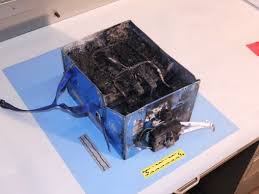

Why the B787 is different


Designed for maximum fuel efficiency, the Dreamliner uses electrical systems to do things that other airliners use pneumatic and/or hydraulic systems for, among them: climate control, pressurization, engine starting, anti-icing, and braking. This eliminates the weight and routing complexity of considerable pneumatic ducts and tubing as well as hydraulic plumbing and equipment, and does away with the parasitic and "stand-by" losses that the conventional systems impose.

To make this all work properly, the Dreamliner is equipped with several sets of Lithium-ion batteries, the first such application in a widebody airliner.

The 787 also marks the first use of a composite primary structure in place of a conventional aluminum fuselage and wing.

What's different about the batteries?


Lithium-ion batteries have been known to overheat and to vent hot toxic and flammable electrolyte if they are abusively overcharged, or if they are discharged faster than they were designed for (as in the case of external short). Physical damage or manufacturing defects within the battery can produce internal shorts that give rise to "thermal runaway". This is where the cell generates more heat as it gets hotter in response to a short in a cycle that can ignite the electrolyte, other battery materials, and surrounding materials.

The 787 design team selected the Lithium-ion batteries due to their lower weight and smaller volume as compared to other chemistries.

What happens next?


The FAA, National Transportation Safety Board (NTSB), Boeing, and its subcontractor/vendor team must continue their investigation and analysis of the battery problems. GS Yuasa in Japan is the supplier of the 787 Li-ion batteries. The avionics system associated with the batteries and electrical supply were designed by Thales SA of France. Once a credible failure mode has been defined and verified by test, a fix can be devised. This can be an operational or periodic maintenance approach, reprogramming of devices that determine and regulate the battery state of charge and discharge/recharge rates, replacement of the batteries, or replacement of other equipment aboard the jet. The problem right now is, without an obvious suspect for the failure, it is impossible to determine what steps will be required, how much time they will take, and how much it all will cost.

One area certain to be examined in detail is the adequacy of the 787's fire detection and suppression system. It is possible that the Halon-based system that has been so successful in previous generations of aircraft (or at least the way it is currently designed) is not effective in combating Li-ion battery fires, either in knocking down the initial fire or in preventing subsequent events driven by thermal runaway.

If the Yuasa battery is found to be at fault, the Boeing team might revise the quality and inspection requirements for the batteries and the cells that comprise them, pursue a redesign, or source replacement Li-ion batteries from an alternate supplier such as Saft. It is also possible that a more conventional and proven (in the airline flight environment) battery chemistry could be selected to replace the Li-ion batteries.

Any and all of these options would entail recertification of the 787 with the proposed modification. Changes to battery construction or chemistry would likely affect the energy density and packaging of the battery. This in turn might alter the capabilities and operating costs of the aircraft.

Bigger picture questions and concerns


The 787 Dreamliner is no doubt a technological tour de force. A valid question is, "have the technology and the methods by which this airplane (and others to follow it) was designed, built, and certified outpaced our abilities to evaluate the design, understand and mitigate risks, and manage the overall program?" A few examples:

  • Outsourcing design as well as construction -- Boeing assembled an international team that not only delivered parts and assemblies per Boeing's design, but rather was responsible for the design and implementation of key assemblies, systems, subsystems, and components. Is it possible that Boeing has lost control of critical parts of this process and the expertise to make informed technical and risk decisions?
  • International participation considerations -- This follows the above point. Airbus (Boeing's only real competitor and no stranger to politico-economic contracting) will claim that the 787 is the most heavily subsidized aircraft in history. All I can say to that is they ought to know. Nonetheless, is it possible that certain key suppliers (for example GS Yuasa) were selected for economic and business reasons rather than for having the best hardware and design? And how well was Boeing equipped to assess and evaluate competing approaches?
  • The FAA certification process -- Similar to the previous point, does the FAA have adequate independent technical experience and expertise to oversee the certification of a novel technological application such as Li-ion batteries in the primary avionics system of a large airliner? I wonder if the FAA was forced to rely too much on Boeing (and Thales, and GS Yuasa, ...).
  • What's the "unknown unknown" looming up ahead, just out of the reach of our technology headlights? -- If I were to have bet three years ago where the 787 would be giving headaches, it would have been associated with the composite construction. Now (and you can call me a sore loser if you wish), I can't help but wonder if some of the "teething issues" don't map back to the structure in some subtle way. For example, could the cracked windscreen panels be driven by something not yet understood about how loads get transferred across the non-metallic structure? 
  • It also occurs to me that it's not impossible that the battery problem ties back to that composite structure. Recall that in "conventional" construction, the entire metal fuselage is the ground plane and grounding and bonding is pretty easy; the predominant consideration in determining ground impedance is resistance. For a composite structure with a dedicated ground network, impedance is more complex, being driven primarily by inductance with resistance a secondary consideration. Is it possible that some not well understood grounding and electrical bonding issue could create electrical/electronic gremlins in the tightly-coupled systems like battery management and braking?
  • What happens the first time a "minor" repair or modification to the 787 composite structure is required or desired?

Some interesting reading that I recommend highly: