10 June, 2013

My Lunch With a Radical Futurist...

Over lunch with one of the most compelling and fascinating conversationalists I've ever known (and he's asked me to keep his name out of this), I assumed the conversation would be heavy on sports, as we shared a table in a Houston Buffalo Wild Wings sports restaurant. But no, we had a far-ranging conversation on a few current topics of national moment. Here are some nuggets:


  • More people die in bus-related accidents in India in a week than have died due to commercial nuclear power since the industry existed.
  • [on the "green-ness" of pure electric cars] The best thing folks can do today is to maintain and continue driving whatever cars they own right now. Manufacture and eventual disposal of battery packs for pure electrics will place on enormous burden on the environment. Cash for clunkers, aside from jacking up the price of all used cars, has at least gotten many of the real rattletraps and gas guzzlers off the road. Electric cars' demands for things like rare earths put the US at a strategic disadvantage with China, a condition we needn't exacerbate.
  • Tesla is a technologically advanced electric but still in no way a "people's car" or a practical sole car for average Americans to own. True long-term costs of ownership remain unknown and ephemeral incentives are fueling a "bubble"that Elon is quite rational to reap.
  • China has no intention of conforming to "environmental norms" for the foreseeable future. This seems to be baked into their "cultural DNA" from the individual to the top apparatuses of government and economic power. Look at the pictures of Beijing smog turning noon into midnight that their leaders are trying to suppress. 
  • When you talk about something like adulterating baby formula in China, that wasn't perpetrated by some ignorant-ass peon. Someone with very advanced knowledge of the chemistry and how the product would be tested was required to figure out what adulterant to use, when to introduce it, and how much was permissible.
  • The leadership in Japan is at some level grateful for the atomic bomb. They see that it saved a good bit of the population from terrible slaughter in fire-bombing campaigns such as had been unleashed on cities like Dresden and Tokyo. On a larger scale, they recognize it saved Japan from Stalin and the experience of eastern Europe post-war.
  • On the topic of sports, he did offer that RG III perhaps was "out there a bit too much" with press conferences, etc., and would be better served by "keeping more mystery". He also reports that he's not been to an Astro's game since they switched to the American League.

09 June, 2013

DRONING ON ABOUT DRONES

DRONING ON ABOUT DRONES


Seems there remains not much new under the sun. Concepts for and actual drones have existed at least since the days of World War II. Granted, these were not the surgically precise death-dealers of today, but drones they were.

Historically drones have been used (or designed to be used) for multiple purposes, among them:

  • Flying active or passive decoys to draw attackers away from "real" aircraft
  • Primitive air-deployed cruise missiles armed with either conventional or nuclear warheads
  • Aerial photography or spy systems
  • "Sniffers" to fly through or around nuclear detonation clouds to sample radioactive debris 
  • Remote control targets for air or ground-based gunnery and missiles. It remains common that conventional aircraft past their prime are converted into drones for this purpose and several of them have lived to perform numerous flights, seemingly unkillable.
Modern drones capitalize on the confluence of technologies that allow them to be more autonomous; higher, faster, longer, and farther flying; reusable; multi-faceted; more perceptive in terms of the sensors they employ; and more accurate and lethal because of the weapons they carry.

Drones can be less intrusive (i.e., quieter and smaller) than a conventional manned aircraft and they can generally be counted on for more persistence over or near a specific location. They certainly ought to be less costly than manned airplanes and, minus the human element, can execute maneuvers that would disable or injure a human pilot. Losing a drone either to accident or enemy fire is not as problematic as losing a human pilot in enemy territory (although recent examples highlight the technological risks of such losses). Most drones today are remotely operated by human pilots. The pilots can be half a world away and their degree of involvement can vary from intensive "stick and rudder" control, setting objectives for a mission, overseeing execution of the mission, to giving final consent to fire a weapon.

Newer and more capable drones can fly their missions completely autonomously, including identifying and selecting targets and making the shoot/don't shoot decision. Therein lies the big moral issue with this new way of waging war: combat without casualties -- except for the bad guys, of course. Recent progress has been made in integrating drones within the hectic and exquisitely coreographed operations of aircraft carriers. Another concern with drone operations is how nicely they can interact with the existing air traffic control system and infrastructure.

25 May, 2013

RAGE AGAINST THE (AUTOMATIC TELLER) MACHINE:


A Rant Against the Evolution of Things Until They Become Less Useful


Not to sound too much like Andy Rooney or anything, but, "do you remember when ATMs were called cash machines?" That was back in the days like maybe mid-70's when ATMs were widely introduced and began their evolution into being useful things. You could go to a cash machine at any time of the day or night and, assuming you had any money in your account and that the machine was actually working, come away with money in your pocket. At first, I viewed ATMs with a jaundiced eye since they seemed poised to let me down when I was most counting on them working. Or at least that was the situation in the ground in Atlanta, Georgia.

Over time the reliability, expressed as the likelihood of a given ATM being capable of dispensing cash on demand, and thus not pissing you off royally, improved markedly. This was probably a result of the confluence of ATM technology improvements and successively more robust networks linking the machines to the central banks.

As the man who had jumped from the roof of a very tall skyscraper was heard to exclaim as he passed by each floor, "So far, so good." ATMs had become unquestionably useful. And that's a good thing.

But more recently I've noted that ATMs have evolved to perform tasks beyond mere dispensing of cash. This, paradoxically enough, is not a good thing. Yesterday I pulled into the ATM lane. By dint of poor planning, I was in a slight hurry as I frequently am. But all systems looked to be go as there was but a lone car in front of me. What I learned was that this particular motorist was using the ATM to renegotiate a jumbo home mortgage that was seriously underwater, fund a micro-loan facility under the auspices of the World Bank, or perhaps commune with Ben Bernanke on QE3. Okay, maybe I'm exaggerating somewhat. In reality my antagonist seemed to be depositing multiple checks (probably birthday money from his grandma, etc.) and some cash in small, wrinkled bills. The money launderer in me recoils at the thought of ever depositing cash; why not hang onto it, throw it on your bed and roll around in it, or use large denomination bills to light cigars?

Anyway, this transaction was taking a long time and I started to conclude that all this high finance could have been more promptly transacted inside the bank with a human teller rather than outside with his car, my car, and now a third car that had pulled in behind me, idling and needlessly despoiling our air. The bile began to rise to my throat. Just at that moment, the car pulled away from the ATM. So now it was my turn and I was determined to conduct my business with all the alacrity and economy of motion of an Indy-500 pitstop. This would render me a hero to the guy behind me. I hummed my ready card into the machine, banged my PIN into the keypad, and was greeted with the message: "THIS MACHINE CANNOT DISPENSE CASH AT THIS TIME."

The failure of the machine accounted for at most twenty percent of my blood pressure rise. Stuff happens, right? But having to wait behind someone conducting a protracted transaction should be avoidable. It never would happen to begin with if ATMs had not evolved beyond their useful purpose as cash dispensers.

My modest proposal is that banks install cash-dispensing-only machines to augment the all-purpose ATMs that I will promise never to use. I realize that this may be problematic in terms of real estate occupied by the ATMs and any drive-up teller lanes but I don't care. Figure it out and get it done.

13 May, 2013

What technologies will near-term new cars feature?

Looks like $80K and up Tesla's notwithstanding, the internal combustion engine will stick around for some time, especially when one considers hybrids.

Pure electric autos have to get a credible 300 mile range (like a real car) and crack the recharge time problem. I can pump 300 miles worth of oomph into my GTO (which has a hearty thirst) in about three minutes, versus half a day for moving electrons around. I'm not saying this won't happen, but it will take some time and investment. Investment in technology for quick-charge batteries and in infrastructure for more ubiquitous charging stations. One option would be an industry-standard battery pack that could be robotically swapped out in minutes. Speaking of industry standards, a "universal" charger and charge control interface is mandatory as an enabler for widespread acceptance of electric cars. Possibly more so than price (within reasonable limits of course).

I wonder about the long-term viability of hybrids since they seem to be neither fish nor fowl and bring along a lot of complexity and cost. Seems to me that a small, light weight car powered by a modern turbo-diesel could eclipse the effective MPG of a hybrid and do so more cheaply in terms of initial cost (and long-term cost of ownership if the battery pack needs to be replaced).

Having gotten that diatribe out of the way, here is what I am seeing in the crystal ball polished through some work (reasonably priced and unreasonable brilliant!!!) I've done for clients in the automotive industry. Look forward (or not) to:

  • Smaller displacement engines of four (or even three) cylinders. These will eschew natural aspiration for supercharging (tuned for performance) or turbocharging (tuned for efficiency).
  • Direct (high pressure) fuel injection
  • More multi-fuel options and greater tolerance for ethanol blends
  • Variable valve timing and a longer term move to electromechanical valve actuation 
  • Start/stop engine technology to reduce emissions and increase MPG in city driving cycles. Having driven a succession of crappy cars in my time, I find an engine that dies at a stop sign unnerving, but I imagine we'll get over it.
  • A proliferation of engine cycles such as the Atkinson cycle. No gas turbines; no Stirling engines yet.
  • Spark plugs as you know and love them will remain with us for some time. There's no big pressure to supplant them with laser initiation (although we could), an they last a long time without trouble. Coil-on-plug will continue to be the standard, and if performance/efficiency demands, we may see two plugs per cylinder in some applications.
  • 100,000 mile "hood welded shut" expectation. We're pretty close to that already. I see increased use by OEMs of full synthetic oil and really long oil change intervals controlled by on-condition sensors (or at least an ECM calculation).
  • Liquid cooling will be retained, but a non-water based fluid will become more dominant.
  • A motor-alternator unit will replace the conventional starter motor and alternator for weight savings and in response to the stop/start feature.
  • Automatic transmissions in their various forms will continue to squeeze the conventional manual gearbox out as cars continue their evolution from something you drive to something you ride in. Number of gear ratios will stop at around eight (I hope) and CVTs will be used beyond that. Bottom line is that we'll be seeing engines optimized around a tight RPM band for economy and emissions.
  • Some high-end drivetrains will incorporate mechanical or pneumatic energy storage in support of regenerative braking.
  • Pre-start oiling systems may allow your rotating and reciprocating engine parts to last forever if the economics work out. Ditto proven cool down post-shutdown controls.
  • Accessories like A/C, cooling fans, and power steering will be electrically driven for max MPG.
  • Driver "aids" like lane departure warning, back-up obstacle warning, parking assist, radar augmented cruise control, and collision avoidance will increase their market penetration as they come down in cost.
  • Increased use of a "car area network" to eliminate cost, weight, installation labor, and failure-susceptibility of conventional wiring harnesses

Thoughts on air-assisted versus ground launch for LEO missions

Most of what I read on this topic is focused on energy considerations -- i.e. how much delta-v can an air launch save versus a "simpler" ground-based multi-stage system. And when you look at it this way, the answer -- somewhat surprisingly and disappointing to my ever hopeful mind -- is not as much as you might imagine or wish for. You will find a good treatment of the situation here:

http://mae.ucdavis.edu/faculty/sarigul/aiaa2001-4619.pdf

The bottom line is, from a purely energetics standpoint, air launch can be viable for relatively small mass payloads (assuming they are within the capabilities of the launcher/carrier aircraft), but it's not anything to write home about. You can compare the perfromance and cost of Orbital Science's Pegasus (air-launched) versus its Taurus (conventional multi-stage ground launch) to get an idea of what I mean.

But I'm thinking that energetics is not the sole or even the primary consideration to be addressed in trades of air versus ground first stages. I see these other factors as being significant drivers to choosing an integrated solution:

  • Options for reuse, especially of high value components
  • Reasonable and survivable (I'm talking of hardware here since I'm not focusing on a human-rated system at this point) abort modes
  • Opportunity for gradual checkout of all vehicle systems prior to commit to flight
  • Enhanced dispatch reliability and launch phasing with respect to an orbital target
  • Minimized time and consumables dedicated to orbital target rendezvous
  • Use of existing hardware to drive down NRE
  • Options for "non-conventional" approaches to system architecture and CONOPS. Things like:
    1. Tow, rather than carry of the flight vehicle
    2. "Leave behind" gear (very massive tires, wheels, brakes, steering actuators, struts, structure)
    3. Transfer of oxidizer and/or fuel from the launcher aircraft while in flight
    4. On-board oxygen generation within the launcher aircraft
    5. Towed UAV that returns to takeoff runway autonomously after releasing the flight vehicle


28 January, 2013

Monday Morning Distraction


While reading through my RSS news feeds, it occurred to me that there was a bumper crop of plausible band names in the headlines. For example:

  • Why the Anger?
  • Can't help but watch
  • Sexual Myopia
  • Relationship Deal Breakers
  • No One Dies on a Plane
  • It Might Not be the Flu
  • Revenge Porn Site
  • Man Boots Own Car
  • Covered in Leeches
  • Cell Phones Ring with Calls for the Dead
  • Bipartisan Group of Senators
  • Rise and Fall of Sarah Palin
  • Comatose Sharon
  • None of the Above Party
  • Harry the Nazi
  • The Citizen Cane of Awful
  • French Revolution for Dummies
  • Hillary and Barack's Lovefest
  • Urgency of Growth

And that's just from a quick pass at this morning's news!

26 January, 2013

Boeing 787 Dreamliner Situation: Summary of what you want to know


The ~$207 million per copy (but only suckers pay M.S.R.P., right?) airliner remains grounded worldwide. 


Some fifty airplanes had been delivered into service, with the majority of these being non-US carriers such as the two Japanese carriers JAL and ANA. United Airlines has taken delivery of 6 planes.

The reason for the grounding is at least two unexplained fires in on-board batteries. The Japanese carriers had decided to ground their fleets as a precaution and the US Federal Aviation Administration (FAA) made it official with the issuance of a mandatory airworthiness directive (AD). ADs typically identify a potentially hazardous condition, state a required corrective action(s), and give a time limit for implementing the corrective measures. What's unusual in the B787 case is that the fleet was ordered grounded immediately (indicative of the perceived seriousness of the problem -- ADs usually give a deadline for making a fix stated in terms of a date, number of takeoffs, or number of flight hours), and no fix has been identified. This means that more than $10 billion worth of brand new airliners are stuck on the ground for an indefinite duration. This is a financial burden for Boeing and the carriers.

Teething Pains bite the 787


It is expected that new airliners experience problems upon introduction into revenue-generating service. The Airbus 380 had some in-flight engine failures and cracks in wing structures. These were resolved relatively quickly. At the dawn of the commercial jet age, the revolutionary De Havilland Comet suffered multiple inexplicable losses where airplanes just seemed to fall out of the sky. Investigation finally revealed metal fatigue due to repeated and rapid pressurization cycles as the culprit. The industry learned a new fact of life for the jet age but the Comet was was swept aside. Ironically, its failure left open the path to domination of the commercial jet market by the Boeing 707 and its progeny.

The 787 experienced some initial problems including fuel leaks, cracked windshields, and computer system glitches in the braking system, as well as the battery failures. The other problems were viewed as correctable; the grounding is solely concerned with the battery issues.

What happened?


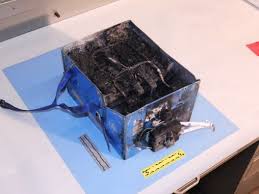
Two lithium-ion batteries in different systems overheated and vented flammable electrolyte outside their cases. Obviously, this is not supposed to happen and several design features are intended to prevent such occurrences. The battery failures and fires could conceivably have resulted in:

  • loss of the system and its functions
  • damage to other systems
  • smoke and potentially hazardous gasses in the cockpit and passenger compartment
  • structural damage due to fire and extreme heat
  • loss of the aircraft
Why this happened is as yet unknown, but flight data recorder evidence indicates that there was no overcharging/overvoltage condition.

Why the B787 is different


Designed for maximum fuel efficiency, the Dreamliner uses electrical systems to do things that other airliners use pneumatic and/or hydraulic systems for, among them: climate control, pressurization, engine starting, anti-icing, and braking. This eliminates the weight and routing complexity of considerable pneumatic ducts and tubing as well as hydraulic plumbing and equipment, and does away with the parasitic and "stand-by" losses that the conventional systems impose.

To make this all work properly, the Dreamliner is equipped with several sets of Lithium-ion batteries, the first such application in a widebody airliner.

The 787 also marks the first use of a composite primary structure in place of a conventional aluminum fuselage and wing.

What's different about the batteries?


Lithium-ion batteries have been known to overheat and to vent hot toxic and flammable electrolyte if they are abusively overcharged, or if they are discharged faster than they were designed for (as in the case of external short). Physical damage or manufacturing defects within the battery can produce internal shorts that give rise to "thermal runaway". This is where the cell generates more heat as it gets hotter in response to a short in a cycle that can ignite the electrolyte, other battery materials, and surrounding materials.

The 787 design team selected the Lithium-ion batteries due to their lower weight and smaller volume as compared to other chemistries.

What happens next?


The FAA, National Transportation Safety Board (NTSB), Boeing, and its subcontractor/vendor team must continue their investigation and analysis of the battery problems. GS Yuasa in Japan is the supplier of the 787 Li-ion batteries. The avionics system associated with the batteries and electrical supply were designed by Thales SA of France. Once a credible failure mode has been defined and verified by test, a fix can be devised. This can be an operational or periodic maintenance approach, reprogramming of devices that determine and regulate the battery state of charge and discharge/recharge rates, replacement of the batteries, or replacement of other equipment aboard the jet. The problem right now is, without an obvious suspect for the failure, it is impossible to determine what steps will be required, how much time they will take, and how much it all will cost.

One area certain to be examined in detail is the adequacy of the 787's fire detection and suppression system. It is possible that the Halon-based system that has been so successful in previous generations of aircraft (or at least the way it is currently designed) is not effective in combating Li-ion battery fires, either in knocking down the initial fire or in preventing subsequent events driven by thermal runaway.

If the Yuasa battery is found to be at fault, the Boeing team might revise the quality and inspection requirements for the batteries and the cells that comprise them, pursue a redesign, or source replacement Li-ion batteries from an alternate supplier such as Saft. It is also possible that a more conventional and proven (in the airline flight environment) battery chemistry could be selected to replace the Li-ion batteries.

Any and all of these options would entail recertification of the 787 with the proposed modification. Changes to battery construction or chemistry would likely affect the energy density and packaging of the battery. This in turn might alter the capabilities and operating costs of the aircraft.

Bigger picture questions and concerns


The 787 Dreamliner is no doubt a technological tour de force. A valid question is, "have the technology and the methods by which this airplane (and others to follow it) was designed, built, and certified outpaced our abilities to evaluate the design, understand and mitigate risks, and manage the overall program?" A few examples:

  • Outsourcing design as well as construction -- Boeing assembled an international team that not only delivered parts and assemblies per Boeing's design, but rather was responsible for the design and implementation of key assemblies, systems, subsystems, and components. Is it possible that Boeing has lost control of critical parts of this process and the expertise to make informed technical and risk decisions?
  • International participation considerations -- This follows the above point. Airbus (Boeing's only real competitor and no stranger to politico-economic contracting) will claim that the 787 is the most heavily subsidized aircraft in history. All I can say to that is they ought to know. Nonetheless, is it possible that certain key suppliers (for example GS Yuasa) were selected for economic and business reasons rather than for having the best hardware and design? And how well was Boeing equipped to assess and evaluate competing approaches?
  • The FAA certification process -- Similar to the previous point, does the FAA have adequate independent technical experience and expertise to oversee the certification of a novel technological application such as Li-ion batteries in the primary avionics system of a large airliner? I wonder if the FAA was forced to rely too much on Boeing (and Thales, and GS Yuasa, ...).
  • What's the "unknown unknown" looming up ahead, just out of the reach of our technology headlights? -- If I were to have bet three years ago where the 787 would be giving headaches, it would have been associated with the composite construction. Now (and you can call me a sore loser if you wish), I can't help but wonder if some of the "teething issues" don't map back to the structure in some subtle way. For example, could the cracked windscreen panels be driven by something not yet understood about how loads get transferred across the non-metallic structure? 
  • It also occurs to me that it's not impossible that the battery problem ties back to that composite structure. Recall that in "conventional" construction, the entire metal fuselage is the ground plane and grounding and bonding is pretty easy; the predominant consideration in determining ground impedance is resistance. For a composite structure with a dedicated ground network, impedance is more complex, being driven primarily by inductance with resistance a secondary consideration. Is it possible that some not well understood grounding and electrical bonding issue could create electrical/electronic gremlins in the tightly-coupled systems like battery management and braking?
  • What happens the first time a "minor" repair or modification to the 787 composite structure is required or desired?

Some interesting reading that I recommend highly: